





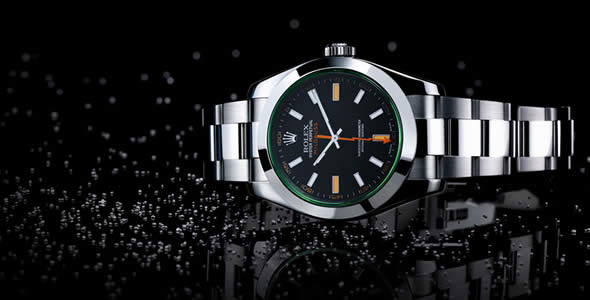

Rolex GMT-Master II Replica: True GMT, Bezel and Movement Guide
GMT-Master II replicas are often sold by bezel colour—Pepsi, Batman, Sprite and other nicknames—but the defining feature is the time-zone function. A convincing replica should be assessed first by how the local hour hand and 24-hour hand operate, then by bezel, date, case and bracelet execution.
The current genuine GMT-Master II family uses a 40 mm case. That provides a reference baseline for proportion, but the replica’s movement architecture determines whether it behaves like the intended watch.
What “true GMT” means in practice
The useful question is whether the local 12-hour hand can be adjusted independently in hour steps while the 24-hour hand continues to track reference time. Some lower-cost GMT movements instead provide an independently adjustable 24-hour hand. Both can display a second time zone, but they are not the same operating system.
Ask for a video of crown operation. Marketing phrases such as “GMT function” or “clone GMT” are too vague on their own.
40 mm case proportion and crown guards
The current Rolex GMT-Master II is 40 mm. Compare lug shape, crown guards, case thickness and bracelet/end-link transition. A thick generic GMT movement can sometimes require a deeper case, so side-profile images are important.
Bezel colour is not enough
Bi-colour bezels are visually dominant, but colour can be distorted by lighting. More reliable QC points include the transition line between colours, numeral alignment, triangle position, engraving consistency and bezel action. The 24-hour bezel should align meaningfully with the 24-hour hand.
Hand stack and clearance
Multiple central hands increase the chance of incorrect stacking height or hand interference. Check that the hands clear one another and the dial markers. If the seller claims a movement with a particular hand stack, ask for side-angle macro photos rather than assuming the stack from the movement name.
Date and Cyclops
GMT-Master II also has a date display. Check window position, digit centering and Cyclops alignment. A true-GMT-style movement should also show coherent local-hour adjustment without causing erratic date behavior.
Bracelet and clasp
Current configurations can use different bracelet styles depending on the reference. Check the exact model rather than assuming one bracelet is universally correct. End-link fit, taper, clasp operation and finishing transitions all affect the result.
Movement architecture and serviceability
A movement may be marketed as a 3285 clone, GMT clone or Swiss GMT. Those labels need clarification. Ask which movement is actually installed, how the local hour hand works, what the power-reserve claim is and whether parts/service are realistically available.
A decorated movement can look closer to the genuine calibre while a more common movement may be easier to maintain. Decide which trade-off matters more before buying.
GMT-Master II QC order
- Verify local-hour and 24-hour hand operation on video.
- Check bezel transition, numeral alignment and 24-hour indexing.
- Inspect case thickness and crown guards.
- Check hand stack/clearance and date/Cyclops alignment.
- Confirm movement identity and service options.
- Check bracelet configuration against the intended reference.
Bezel rotation and 24-hour reading
A GMT-Master II bezel is not only decorative. It lets the wearer offset the 24-hour scale to read an additional time zone. Check that the bezel rotates in the expected increments and that the triangle and numerals line up cleanly with the dial. Excessive play can make the second-time-zone reading visually imprecise even when the movement itself works correctly.
Popular nicknames can hide reference differences
Terms such as Pepsi, Batman, Batgirl or Sprite are convenient colour nicknames, not complete specifications. Bracelet type, crown side, case generation and movement can differ. When a seller uses a nickname, confirm the exact case/dial/bezel configuration rather than assuming all watches with the same colours are equivalent.
Local-hour jump and date interaction
On a true-GMT-style implementation, independently moving the local hour hand can also affect the date when the hand crosses midnight. A useful demonstration therefore includes both forward and backward hour jumps around the date-change boundary. This reveals more about the movement than simply showing that the 24-hour hand moves. If the date behaves unpredictably or the local hour hand cannot be adjusted independently, the movement is using a different GMT architecture.
Left-hand and conventional case layouts
The modern GMT-Master II family includes configurations that change crown orientation. Replica sellers sometimes copy a popular bezel colour but overlook the matching crown/date layout. When evaluating an unusual configuration, check the entire case/dial orientation rather than assuming the nickname is enough. A left-hand-style watch with a conventional right-side date/crown arrangement would be a mixed design, not an accurate reproduction of that reference.
GMT-Master II FAQ
Does a fourth hand prove a true GMT movement?
No. The key difference is how the local 12-hour hand and 24-hour hand are adjusted.
Are bezel colours reliable in product photos?
Only partly. Lighting and editing can change colour. Alignment, engraving and transition placement are more stable checks.
Is GMT-Master II the same size as Explorer II?
No. Current GMT-Master II is 40 mm, while current Explorer II is 42 mm.